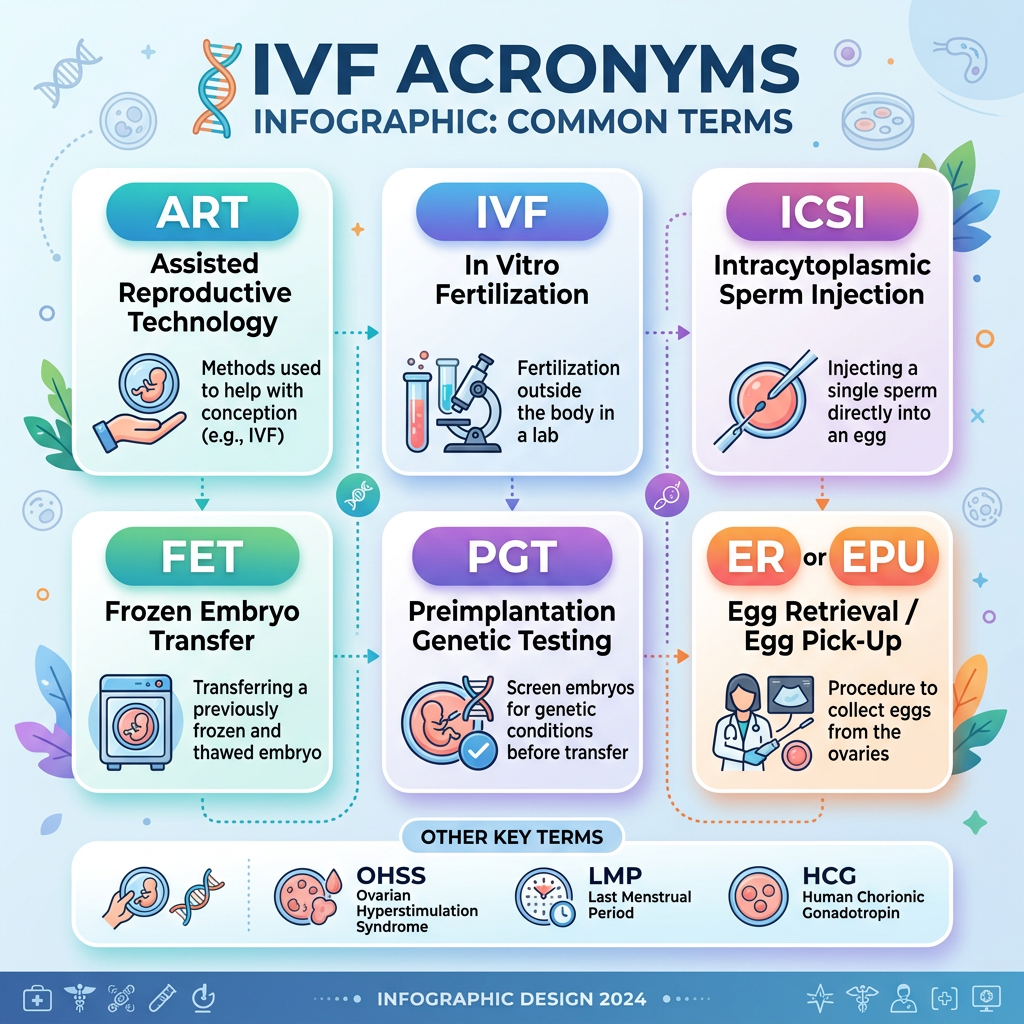
Starting fertility treatment can feel like learning an entirely new language. Between IVF appointments, fertility forums, bloodwork updates, and conversations with your clinic, you may suddenly hear dozens of confusing abbreviations like FET, ER, AMH, PGT-A, and TWW. For many beginners, IVF acronyms can make the fertility journey feel even more overwhelming.
The good news is that once you understand the most common fertility terms, navigating IVF treatment becomes much easier. Knowing these IVF acronyms may help you feel more informed, confident, and less anxious during appointments and online research.
This beginner-friendly guide explains the most common IVF acronyms every fertility patient should know in simple terms.
Why IVF Acronyms Matter
Fertility clinics, IVF communities, and online support groups often use abbreviations to simplify long medical terms.
Understanding IVF acronyms may help you:
- Follow fertility discussions more easily
- Understand clinic instructions
- Feel more prepared during appointments
- Reduce confusion during treatment
- Navigate IVF forums with less stress
While the terminology may feel intimidating at first, most patients become familiar with these fertility terms very quickly.
1. IVF = In Vitro Fertilization
IVF stands for In Vitro Fertilization.
This is the fertility treatment process where:
- Eggs are retrieved from the ovaries
- Fertilization happens in a laboratory
- Embryos are created and monitored
- Embryos are transferred into the uterus
IVF is one of the most commonly discussed fertility treatments.
2. IUI = Intrauterine Insemination
IUI stands for Intrauterine Insemination.
During IUI:
- Sperm is placed directly into the uterus around ovulation
IUI is generally less invasive than IVF treatment and may be recommended before moving to IVF depending on fertility diagnoses.
3. TTC = Trying to Conceive
TTC is one of the most common fertility acronyms online.
TTC simply means:
- Trying to conceive
You will often see this abbreviation in fertility forums, social media groups, and IVF communities.
4. RE = Reproductive Endocrinologist
An RE is a fertility specialist doctor who focuses on:
- Infertility
- Hormones
- IVF treatment
- Reproductive medicine
Your RE usually oversees:
- IVF protocols
- Medication plans
- Egg retrieval
- Embryo transfer
5. AMH = Anti-Müllerian Hormone
AMH is a hormone commonly measured during fertility testing.
AMH levels may help estimate:
- Ovarian reserve
- Expected IVF response
- Approximate egg quantity remaining
AMH is one of the most commonly discussed fertility blood tests.
6. FSH = Follicle-Stimulating Hormone
FSH is a hormone involved in:
- Follicle growth
- Egg development
- Ovulation
FSH bloodwork is often used during fertility evaluations and IVF treatment.
7. ER = Egg Retrieval
ER stands for Egg Retrieval.
This is the IVF procedure where mature eggs are collected from the ovaries after ovarian stimulation.
Egg retrieval usually happens:
- About 34–36 hours after the trigger shot
Many fertility forums frequently use ER when discussing IVF timelines.
8. ET = Embryo Transfer
ET stands for Embryo Transfer.
This is the procedure where an embryo is transferred into the uterus during IVF treatment.
Types of embryo transfer may include:
- Fresh embryo transfer
- Frozen embryo transfer (FET)
9. FET = Frozen Embryo Transfer
FET stands for Frozen Embryo Transfer.
In this process:
- Previously frozen embryos are thawed
- The embryo is transferred into the uterus
Frozen embryo transfer cycles are extremely common in modern fertility treatment.
10. TWW = Two-Week Wait
The TWW refers to the emotionally difficult waiting period between:
- Embryo transfer
and - Pregnancy testing
During the two-week wait, many women experience:
- Anxiety
- Symptom checking
- Emotional stress
- Waiting for beta hCG results
TWW is one of the most commonly used IVF acronyms online.
11. Beta = Beta hCG Blood Test
“Beta” refers to the beta hCG blood test used to confirm pregnancy after IVF treatment.
This blood test measures:
- Human chorionic gonadotropin (pregnancy hormone)
Beta testing usually occurs:
- About 9–14 days after embryo transfer
12. BFN = Big Fat Negative
BFN is a common fertility forum abbreviation meaning:
- Negative pregnancy test
This acronym is frequently used in IVF communities and TTC discussions.
13. BFP = Big Fat Positive
BFP means:
- Positive pregnancy test
You will often see this acronym used during discussions about IVF success and pregnancy announcements.
14. PGT-A = Preimplantation Genetic Testing for Aneuploidy
PGT-A is genetic testing performed on embryos before transfer.
PGT-A helps evaluate embryos for:
- Chromosomal abnormalities
This testing may help fertility clinics identify embryos with normal chromosome numbers before frozen embryo transfer.
15. OHSS = Ovarian Hyperstimulation Syndrome
OHSS is a possible complication of ovarian stimulation during IVF treatment.
Symptoms may include:
- Severe bloating
- Rapid weight gain
- Shortness of breath
- Abdominal pain
Mild bloating during IVF is common, but severe symptoms should always be reported to your fertility clinic.
16. ICSI = Intracytoplasmic Sperm Injection
ICSI is a fertilization technique used during IVF.
With ICSI:
- A single sperm is injected directly into an egg
ICSI is often used in cases involving:
- Male factor infertility
- Previous fertilization issues
17. CD = Cycle Day
CD stands for Cycle Day.
For example:
- CD1 = First day of your menstrual period
- CD10 = Tenth day of your cycle
Fertility clinics often schedule medications and monitoring appointments based on cycle days.
18. US = Ultrasound
US refers to:
- Ultrasound monitoring
During IVF treatment, ultrasounds help monitor:
- Follicle growth
- Ovarian response
- Endometrial lining
19. LH = Luteinizing Hormone
LH is a hormone involved in ovulation.
During IVF treatment, LH levels may be monitored to:
- Prevent premature ovulation
- Track hormonal response
20. E2 = Estradiol
E2 refers to estradiol, a form of estrogen monitored during ovarian stimulation.
Estradiol levels help fertility clinics evaluate:
- Follicle growth
- Ovarian response
- Medication adjustments
Why IVF Terminology Can Feel Overwhelming
Many fertility patients feel emotionally overwhelmed by:
- Medical terminology
- IVF abbreviations
- Online fertility language
This is completely normal.
The IVF process already involves:
- Emotional stress
- Hormonal changes
- Frequent appointments
- Information overload
Learning fertility acronyms gradually can help treatment feel more manageable over time.
Tips for Managing IVF Information Overload
Helpful strategies include:
- Keeping a fertility journal
- Writing down unfamiliar terms
- Asking your clinic questions directly
- Avoiding excessive fertility forum comparisons
You do not need to memorize every IVF term immediately.
Most patients naturally become more comfortable with fertility language throughout treatment.
Final Thoughts on IVF Acronyms
IVF acronyms can feel confusing at first, but understanding common fertility terms may help reduce anxiety and improve confidence during fertility treatment. From ER and FET to TWW and PGT-A, these abbreviations become part of everyday IVF conversations for many patients.
Remember:
- IVF terminology gets easier with time
- Asking questions is always okay
- Fertility treatment already involves a lot emotionally
- You do not need to understand everything immediately
- Learning gradually is completely normal
Most importantly, be patient with yourself during the IVF journey. Fertility treatment comes with a steep learning curve, and feeling overwhelmed by new terminology is a very common part of the process.
Leave a Reply